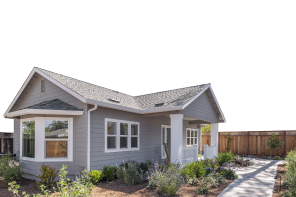

BIG news for California!
You can now legally sell your ADU separately from your property thanks to Assemblymember Ting’s bill AB 1033. This has been an action that homeowners in California have been advocating for years ever since ADU regulations began loosening and these small homes exploded in popularity. When looking at the current real estate landscape, it’s no wonder that this legislation is considered a game-changer.
The ability to sell ADUs independently provides homeowners with newfound flexibility and potential financial opportunities, reflecting the evolving and dynamic nature of California’s real estate market. As ADUs continue to play a pivotal role in addressing housing needs, AB 1033 opens up innovative possibilities for homeowners seeking to maximize the value and potential of their properties.
What is AB 1033 (Ting)?
AB 1033 is a California bill that was drafted by Assemblymember Phil Ting to allow the sale and condo-ization of ADUs built on a residential property. Individual cities and counties would have the freedom to decide if they want their residents to have the option to sell their ADUs.
What does condo-ization mean?
When you think of a condo, what comes to mind?
Many people imagine a condo as a type of building. But in reality, it’s a form of property ownership — co-ownership.
Condo-ization involves determining the individual units that will make up a single property and allocating ownership of these separate units to different owners. This allows two or more distinct parties to legally own discrete parts of the same property without subdividing (i.e. physically splitting) it.
Therefore, a condo-ized ADU means that the ADU is part of a co-owned property with one party owning the primary residence and the other party owning the ADU. Under these terms, the ADU is considered a separate entity from the main home and can be sold separately.
While almost any property has the ability to be condo-ized, not every property had the permission to do so.
That’s where AB 1033 comes in! With this bill, all of that is going to change.

What could AB 1033 mean for California?
AB 1033 could have several positive impacts on California.
For starters, it could increase gentle density in many cities. Unlike high density (e.g., mid- and high-rise residential buildings), gentle density refers to the development of single-family type units (e.g., ADUs, duplexes, etc.) within single-family zoned neighborhoods. Gentle density helps maintain the residential façade and aura of neighborhoods while offsetting the growing housing crisis.
The passing of AB 1033 could also provide more affordable housing opportunities for low-mid income first-time homeowners.
It’s no secret that California has astronomically high housing prices right now. To give you a better idea, the average home price in California currently falls between $700k – $1M. This price range is simply unattainable for many working families.
But remember, AB 1033 allows ADUs to be sold independently from the primary residence. This will open up a reservoir of reasonably priced homes for first-time homebuyers.
After all, ADUs are a much more affordable housing option than a 2,000+ sq ft home. Household sizes have shrunk to all-time lows since the 60s when a lot of these homes were built. A lot of families just don’t have a need for five-bedroom houses anymore.
AB 1033 will also be advantageous to current homeowners who could use the sale of an ADU to help finance its construction. It also allows homeowners who do not want to be landlords to simply build the ADU for sale. This would allow more families a chance at homeownership.
ADU Condo-ization has a proven track record
Not only is AB 1033 realistic, but it is already working in other locations! Some notable success spots include Seattle, WA, Austin, TX, Portland, OR, and Princeton, NJ! In fact, they have been succeeding at this for years, helping to alleviate the widespread housing crisis.
Let’s take Seattle, for instance, which has been condo-izing ADUs for decades.

With an outrageous median house price in Seattle of $1.2M, a growing number of ADUs have been built in recent years to offset their housing crisis. In fact, almost 1,000 ADUs were permitted in 2021, which is an increase of 250% from the previous year!
According to The Seattle Times, approximately 1/3 of new ADUs are being permitted as condos. This is all part of a heightened effort on Seattle’s part since 2019 to loosen ADU regulations. This will provide a wider, more financially accessible array of housing opportunities.
Now that’s something we can get behind!
It should be noted that condo-ized ADUs are not always cheap; the median price for a condo-ized ADU in Seattle hovers around $732,000. However, compared to the cost of full-sized homes in the area (1.2M!), these ADUs still save homeowners hundreds of thousands of dollars.
How is this AB 1033 different from SB 9?
The difference between AB 1033 and SB 9 lies in the fine technical details. SB 9 deals with lot splits and duplexes. For example, you can split a portion of your land as is, or build a single-family residence or duplex on the property. This does NOT have to do with ADUs. AB 1099 addresses ADUs specifically. Rather than selling the lot, you are selling the ADU as a condo.
Another big difference is that SB 9 is a statewide mandate. Your city must allow you to split your lot or build a duplex if your property meets all of the qualifications. AB 1033 only gives cities the option to allow condo-ized ADUs. Cities can choose whether to integrate this option into their local ordinances, granting them a level of autonomy in deciding the suitability of this approach for their respective communities.
When deciding which is the best option, it will depend on your situation. It’s worth noting that with SB 9, you might have more freedom with size as the homes are classified as single-family or duplexes. ADUs have a size limit of 1,200 sq. ft. Selling a portion of your land with a house or duplex also may earn you a higher ROI than a condo-ized ADU.
What are the requirements for condo-izing an ADU?
While AB 1033 creates exciting new opportunities for homeowners, condo-izing an ADU is not as simple as putting the unit on the market. Local jurisdictions must first adopt ordinances allowing ADU sales, and homeowners will typically need to meet additional legal and financing requirements. This can include creating separate utility arrangements, establishing shared property agreements, and complying with condominium mapping procedures.
Homeowners should also understand that condo-ized properties often involve homeowners association-style agreements between the primary home and ADU owner. These agreements help outline responsibilities for shared spaces, maintenance, insurance, and property access. Because the process can be complex, working with experienced ADU professionals, surveyors, and real estate attorneys is highly recommended before moving forward with an ADU intended for separate sale.
What cities allow for ADU condo-ization?
As of 2026, San Jose is the only city that allows for condo-ization of ADUs. This is a very new development, but we have high hopes to see this take off in the coming years. Because of the tech boom, San Jose has become one of the most expensive cities to live in United States.
Families that have lived in the area for generations now find themselves struggling to afford staying close to loved ones. If more ADUs become available for purchase, this could mean more citizens will have the opportunity to own homes. We’ve already seen this take place in Portland!
Plan, hire, and manage your ADU project with Maxable!
We’ve seen firsthand how ADUs have benefitted hundreds of homeowners over the years. We’re eager to see AB 1033 hopefully come to fruition!
In the meantime, if you see an upcoming ADU project on your horizon, then let Maxable kickstart it into motion! Simply provide your address, give us a brief rundown of your project, and we’ll take it from there by matching you to a vetted network of reliable ADU designers and builders in your area.
We hope to connect with you soon!