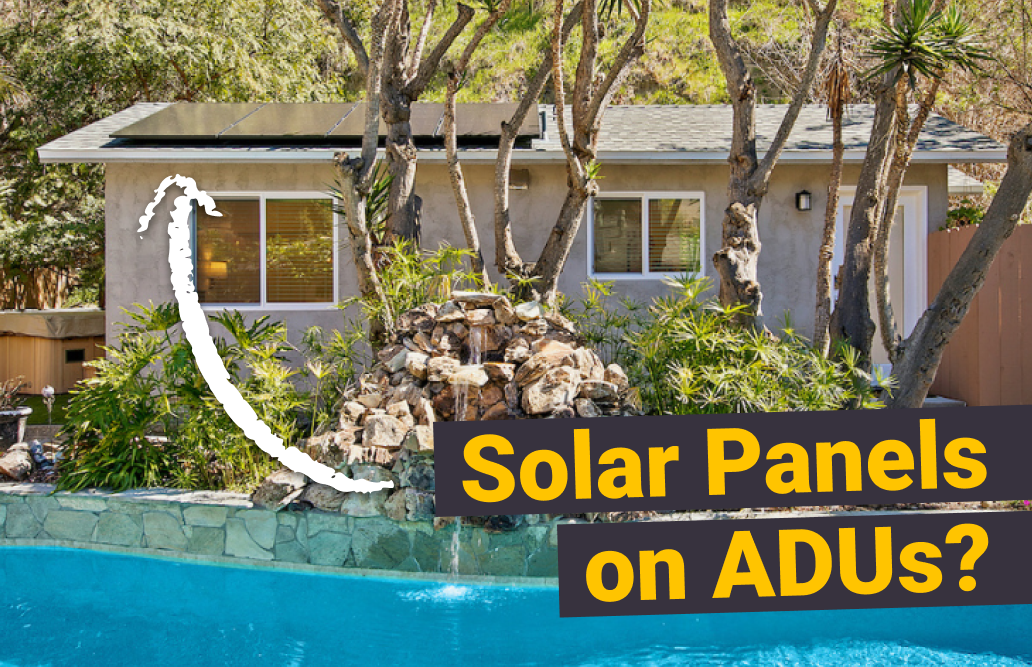
Thinking about whether your ADU needs solar? California’s energy rules can be confusing, especially since requirements vary based on your project type, size, and whether you’re building new or converting an existing structure.
The good news is that the solar rules for ADUs are much more flexible than most homeowners expect. In this guide, we’ll break down exactly when solar is required, when it’s optional, and how to decide if adding panels is actually worth the investment for your property.
At Maxable, we make the ADU process easier with step-by-step education through videos, blogs, and webinars. If you’re just getting started, be sure to download our free ADU Tool Kit for checklists, examples, and expert insights to guide your project.
When Solar Is Required for ADUs
Under Title 24 (Part 6 of the California Energy Code), most newly-constructed, detached ADUs must include a solar panel system.
That means if you’re building an ADU from the ground up, a new, separate building on a residential lot, the default expectation is that you add solar power. The panels can be installed on the ADU itself, the main house roof, or other eligible roof/ground structures on the same lot.
When ADUs Are Often Exempt From Solar Panels

There are several common cases where solar is not required. The most notable instances of when solar is NOT required include garage conversions, attached ADUs, internal conversions of a portion of the main house, and most ADUs powered through the main house.
Let’s take a closer look.
Garage Conversions
Most garage conversions are exempt from solar requirements because they are not considered new construction. You’re converting an already-built structure into livable space, not adding new conditioned square footage.
Key points:
- No new roofline = no mandatory solar.Solar is triggered when you create new roof area that could support panels. A converted garage keeps its existing roof exactly as is (or at least a similar roof in full demolition cases).
- The electrical load increase is typically minimal for garage conversions, which also keeps them outside the triggers that require solar or a main panel upgrade.
Internal/Existing Space Conversions
If you’re converting any part of the home that already exists, such as an attic, basement, bonus room, or recreation room, you generally do not need to install solar.
Why:
- These projects fall under “existing conditioned or unconditioned space being repurposed,” which is not treated as new construction by the California Energy Code.
- Since no new building envelope or roof is added, the project does not meet the threshold that activates the solar mandate.
Attached ADUs
Attached ADUs, those that share at least one wall with the main home, are often exempt from solar requirements when they do not create a new independent structure. Because these additions rely on the existing home’s electrical system, structural envelope, and in many cases the existing roof, they typically fall under the primary residence’s compliance rather than being treated as a standalone unit.
If you’re unsure if your ADU qualifies for a solar exemption, you can ask our team of ADU experts. We can take a look at your property and answer any other questions you may have. Click here to get connected for free.
When Solar Is Optional, But Still Worth Considering

Even when solar isn’t required by code, many homeowners still choose to install it because the long-term benefits often outweigh the upfront cost. Here are the most common reasons why.
High Utility Costs
Electricity rates in California continue to rise, and an ADU, whether attached or converted, adds new demand to your home’s electrical load.
Even if solar isn’t mandated, installing it can significantly reduce long-term utility expenses for both the main house and the ADU.
Increasing Property Value
Solar remains one of the most reliable home improvements for boosting resale value.
Homes with solar typically sell faster, and ADUs with lower operating costs tend to attract higher rents and stronger tenant interest.
Incentives and Rebates
The federal 30% Solar Investment Tax Credit (ITC) is still available, and some cities or utilities occasionally offer additional rebates.
Because programs change frequently, homeowners should check current federal, state, and utility-level incentives before making a decision.
Electrification Goals
All-electric ADUs benefit the most from solar since they rely fully on electricity for heating, cooling, water heating, cooking, laundry, and EV charging.
Solar can offset much of that load and help future-proof the home as California continues its move toward electrification.
When Solar Might Not Be Worth It For Your ADU

Even though solar is increasingly common, and in many cases required, not every ADU project benefits equally from installing panels. In some situations, the financial return, energy output, or practicality simply doesn’t justify the investment. Below are the most common scenarios where homeowners may want to think twice before committing to a solar system for their ADU.
Lots With Poor Sun Exposure
Might be hard to believe in sunny California, but some lots just don’t get enough sun to justify getting solar panels.
Solar works best with unobstructed sunlight for most of the day. If your property is heavily shaded by mature trees, surrounding multi-story homes, or sits on a north-facing slope, panel performance drops significantly. In these cases, the system might produce only a fraction of its rated output, meaning you pay full price for panels that underdeliver year after year.
Before committing, homeowners should request a solar site assessment or a sun-hour analysis. These reports estimate annual energy generation. If the projected output is low, solar may not provide meaningful savings.
Low-Energy ADUs With Minimal Power Usage
Some ADUs simply don’t consume much electricity. For example:
- Small studios
- Compact 1-bedroom units
- Units with high-efficiency heat pumps, LED lighting, and low appliance loads
If your ADU’s estimated monthly usage is minimal, the payback period for solar can stretch far longer than average, sometimes 15–25 years. In these cases, the system may never generate enough savings to fully offset its cost.
This is especially true for attached ADUs that share climate control or plumbing infrastructure with the main house, and therefore draw far less power independently.
Making the Right Decision for Your ADU

California’s solar rules for ADUs can feel complicated, but once you understand how the state distinguishes between new conditioned space, existing structures, and attached expansions, the path forward becomes much clearer. The big takeaway is this: solar isn’t automatically required for every ADU, and in many cases, you have options.
If you’re unsure whether your ADU will require solar, or you want a professional to review your design before you commit, Maxable is here to help. Our team has guided thousands of homeowners through California’s ADU rules, and we connect you only with vetted architects, designers, and builders who understand the solar regulations inside and out.
Ready to move forward with confidence? Book a call with Maxable today. We’ll match you with the right ADU professionals to streamline your process, avoid costly mistakes, and get your project all the way to the finish line.