Updated September 2026: We rewrote our AB 462 section. An earlier version said AB 462 exempts Los Angeles County ADUs from coastal permits. It doesn’t. AB 462 puts a 60-day deadline on coastal permit decisions for ADUs and lets some ADUs in disaster areas get approved for move-in before the main house. We also added SB 9 (2025), a fourth ADU bill signed the same day, and tightened a few details on SB 543 and AB 1154.
California ADU laws changed again for 2026, and the updates matter if you’re planning to build. Recent years were about making ADUs legal almost everywhere. The newest laws fine-tune how cities process permits, charge fees, handle JADU rentals, and treat ADUs in coastal and disaster-affected areas.
Governor Newsom signed four ADU bills on October 10, 2025: SB 543, AB 1154, AB 462, and SB 9 (2025). They build on existing ADU rules and close loopholes that led cities to enforce the same rules differently. Some of these changes lower costs for smaller units, and some speed up approvals.
Here’s what each law does and what it means if you’re planning to build an ADU in California in 2026 or beyond.
Key Takeaways
- SB 543: ADU and JADU size limits are now measured in square feet of interior livable space. Cities must tell you within 15 business days whether your application is complete. Smaller units skip impact fees and school fees.
- AB 1154: You no longer have to live on the property if your JADU has its own bathroom. JADU rentals must be for longer than 30 days.
- AB 462: Coastal ADUs still need a Coastal Development Permit, but the decision now comes with a 60-day deadline, and a city’s decision can’t be appealed to the Coastal Commission. In some disaster areas, a detached ADU can get its certificate of occupancy before the main house.
- SB 9 (2025): A city’s ADU ordinance is null and void if the city doesn’t send it to the state housing department within 60 days of adopting it. This is not the 2021 SB 9 lot-split law.
- Timing: AB 462 took effect October 10, 2025. SB 543, AB 1154, and SB 9 took effect January 1, 2026.
A Quick Overview of ADU Laws in 2026
The 2026 ADU updates aren’t a full overhaul. Mostly, they clarify rules that cities were reading differently and give the state more say over local ADU ordinances. These laws apply statewide, and state ADU law overrides local rules that conflict with it.
Here’s the short version:
| Bill | What it changes | Who it helps most | In effect since |
|---|---|---|---|
| SB 543 | Size measured as interior livable space, 15-business-day completeness check, fee exemptions for smaller units, JADU ordinance rules | Anyone applying for an ADU or JADU permit, especially small units | January 1, 2026 |
| AB 1154 | No owner-occupancy for JADUs with their own bathroom; JADU rentals must be longer than 30 days | Homeowners adding a JADU they may rent out | January 1, 2026 |
| AB 462 | 60-day deadline on coastal permits for ADUs, no Coastal Commission appeals of local decisions, early occupancy for detached ADUs in some disaster areas | Coastal homeowners and families rebuilding after a declared disaster | October 10, 2025 |
| SB 9 (2025) | City ADU ordinances are void if not sent to the state within 60 days of adoption | Homeowners in cities with outdated or noncompliant ADU rules | January 1, 2026 |
SB 543: Clarifying ADU Standards and Reducing Small-Unit Costs
SB 543 is largely a cleanup and clarification bill, but those clarifications matter.
What SB 543 Does For ADUs
1. Clarifies how ADU size is measured
SB 543 says the square footage limits for ADUs and JADUs refer to interior livable space. That means the space inside the unit that’s meant for living, sleeping, eating, cooking, or bathing. Having one standard in state law gives cities less room to measure size their own way.
2. Exempts smaller units from impact fees and school fees
Impact fees are one-time charges some cities add to new construction. Under SB 543, cities can’t charge them on an ADU with 750 square feet of interior livable space or less, or a JADU with 500 square feet of interior livable space or less.
School fees work a little differently. An ADU or JADU with less than 500 square feet of interior livable space is exempt from school impact fees. For smaller or budget-focused ADUs, that’s real money saved.
3. Reinforces ministerial approval and local ordinance rules
“Ministerial” means the city approves your permit by checking it against clear, objective rules, with no public hearing and no case-by-case judgment call. SB 543 extends this to JADUs: if your city hasn’t adopted a JADU ordinance, JADU applications still get processed ministerially under state law. Cities also have to send their JADU ordinance to the state housing department within 60 days of adopting it.
4. Cities must check ADU and JADU applications for completeness within 15 business days
Permitting agencies must tell you in writing whether your ADU or JADU application is complete no later than 15 business days after they receive it. If anything is missing, the notice has to list what’s incomplete and explain how to fix it. You can then correct and resubmit, and the city can’t add new items that weren’t on its original list. If the city misses the 15-business-day deadline, your application is considered complete.
If your application is found incomplete or denied, the city also has to give you a way to appeal, and it must issue a final written decision within 60 business days of your appeal.
Why SB 543 Matters
Clearer rules leave less room for a city to read the law its own way, and that’s where a lot of ADU delays come from. SB 543 also protects homeowners from fees on smaller units and puts a clock on the very first step of the permit process.
AB 1154: Changes to JADUs, Rentals, and Owner-Occupancy
AB 1154 is narrowly focused on Junior ADUs (JADUs), the small units of up to 500 square feet built inside your existing house. It makes one change on owner-occupancy and one on rentals.
What AB 1154 Changes
1. Owner-occupancy is no longer required for JADUs with their own bathroom
Under AB 1154, owner-occupancy only applies if the JADU shares a bathroom with the main house. If the JADU has its own bathroom, owner-occupancy can’t be required. Before this change, JADU ordinances had to require the owner to live in either the JADU or the main house.
For homeowners, this makes JADUs more workable as true long-term housing units.
2. JADU rentals must be longer than 30 days
AB 1154 requires local JADU ordinances to say that a JADU can only be rented for a term longer than 30 days. In plain terms, JADUs can’t be used as short-term vacation rentals.
Here’s what AB 1154 does not do:
- It doesn’t change the rules for standard ADUs. Some ADUs already have to be rented for more than 30 days under existing state law, and for others, cities can decide whether to require it.
- It applies only to JADUs.
Why AB 1154 Matters
The owner-occupancy change is a big deal if you want flexibility. If your JADU has its own bathroom, you can rent it out long-term even if you move away, while the 30-day minimum keeps JADUs from turning into vacation rentals. If you’re weighing a JADU against a full ADU, our JADU pros and cons guide walks through the tradeoffs.
AB 462: 60-Day Coastal Permit Deadline and Disaster-Area Occupancy
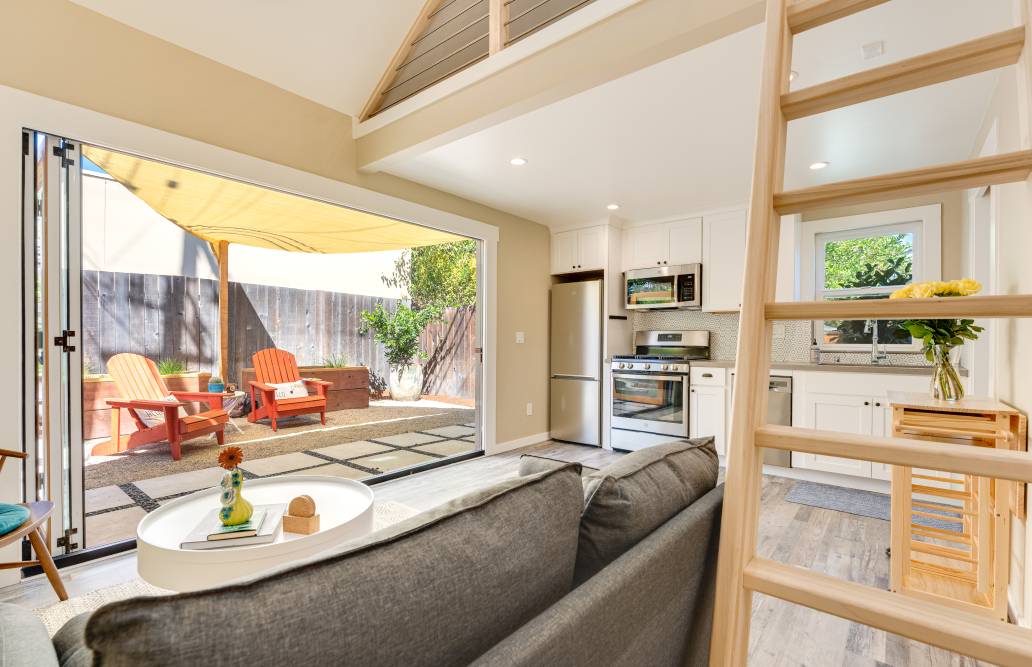
AB 462 does not exempt ADUs from coastal permits. If your property is in California’s coastal zone, you still need a Coastal Development Permit (CDP) for your ADU. What AB 462 changes is how long that permit decision can take and whether it can be appealed.
A CDP is the extra permit the California Coastal Act requires for most building in the coastal zone, on top of your regular ADU permit. It’s a separate review, so it can add time to a coastal ADU project. AB 462 was signed on October 10, 2025, as an urgency law, so it took effect that same day instead of waiting for January 1, 2026.
Let’s break it down.
What AB 462 Does
1. Puts a 60-day deadline on coastal permits for ADUs
If your city or county has a certified local coastal program (its own state-approved coastal plan), it must approve or deny your ADU’s CDP within 60 days of receiving a complete application. That review runs alongside your regular ADU permit review. Local governments still aren’t required to hold public hearings for ADU coastal permits.
If your city doesn’t have a certified local coastal program, the CDP goes to the California Coastal Commission. The city has to notify the Commission right away once your ADU application is complete, and the Commission then has 60 days to approve or deny your completed CDP application. If the Commission doesn’t act within 60 days, the application is deemed approved.
One exception: if you submit the ADU’s CDP application together with a CDP application for a brand-new main house on the same lot, the Commission can hold its ADU decision until it decides on the main house.
2. Ends Coastal Commission appeals of local ADU decisions
Before AB 462, a local coastal permit decision on an ADU could be appealed to the Coastal Commission if the property was in the Commission’s appeal area. Now, a local government’s CDP decision on an ADU can’t be appealed to the Coastal Commission. Once your city decides, that decision doesn’t get a second round at the state level.
3. Lets some ADUs in disaster areas get occupancy before the main house
Normally, a city can’t issue a certificate of occupancy for your ADU (the sign-off that says people can legally live in it) until the main house gets its own. AB 462 creates an exception. The city must issue the ADU’s certificate of occupancy first when all of these are true:
- The property is in a county where the Governor proclaimed a state of emergency on or after February 1, 2025.
- The main house was substantially damaged or destroyed by the event named in that proclamation.
- The ADU has its construction permits and has passed all required inspections.
- The ADU is detached. The exception doesn’t apply to an ADU attached to the main house.
In practice, if a declared disaster damages your home, you could finish a backyard ADU and move in while the main house is still being rebuilt.
A note for Los Angeles homeowners: the state of emergency for the January 2025 Los Angeles County fires, including the Palisades and Eaton fires, was proclaimed on January 7, 2025. That’s before the February 1, 2025 cutoff, so as the law is written, this exception doesn’t reach homes lost in those fires. Los Angeles County was later included in a December 24, 2025 proclamation for the late December storms, which could apply to a home substantially damaged in those storms. Your local building department can confirm whether your property qualifies. If you’re rebuilding after the fires, our guide to building an ADU in Altadena after the 2025 fires covers the local rules.
4. Applies to charter cities too
AB 462 declares that these changes address a matter of statewide concern, so they apply to all cities, including charter cities that would otherwise claim local control.
Who AB 462 Helps
Coastal homeowners get a firm 60-day deadline on a permit that the state’s ADU deadline didn’t cover before, and a local approval that can’t be appealed to the Coastal Commission. That makes coastal ADU timelines more predictable, though the rest of your permit process still depends on your city.
Families rebuilding after a qualifying disaster can move into a detached ADU once it passes its inspections, without waiting for the main house to be finished.
Maxable Pro Tip: Before you apply, ask your city whether it has a certified local coastal program. That tells you whether your CDP stays with the city or goes to the Coastal Commission. Our guide to building an ADU in a coastal overlay zone covers the rest of the process.
SB 9 (2025): Cities Must Send Their ADU Rules to the State
SB 9 (2025) adds a penalty to a rule cities were already supposed to follow. Quick heads-up: this is not the 2021 SB 9 lot-split law you may have heard about. Same bill number, different law. (If you’re curious about that one, here’s our SB 9 lot-split explainer.)
California already required cities to send a copy of their ADU ordinance to the California Department of Housing and Community Development (HCD), the state housing agency, within 60 days of adopting it. Under SB 9 (2025), a city’s ADU ordinance is null and void if the city doesn’t send it within 60 days. The same happens if HCD finds the ordinance doesn’t comply with state law and the city doesn’t respond within 30 days.
When an ordinance is voided, the city has to apply the state’s ADU standards until it adopts one that complies. For you, that means a city can’t keep enforcing local ADU rules it never sent to the state for review.
ADU Laws in 2026 Continue the Same Trend
The 2026 California ADU laws don’t reverse course. They continue the state’s long-term push to make ADUs easier to build. Clearer definitions and firm deadlines on permit decisions take away a lot of the back-and-forth that has slowed projects in the past. If you want to see how we got here, our rundown of the ADU laws that took effect in 2025 covers the previous round.
How smoothly your project goes still depends a lot on your local permit office, so it helps to work with ADU pros who know it. Fees still vary a lot by city, so it’s worth running the numbers early with our ADU cost guide.
FAQs
Does AB 462 exempt ADUs from needing a Coastal Development Permit?
No. ADUs in California’s coastal zone still need a Coastal Development Permit. AB 462 requires the permit decision within 60 days of a complete application and makes a local government’s decision on an ADU coastal permit not appealable to the Coastal Commission.
How long does the city have to decide on a coastal permit for my ADU?
60 days from a complete application. If your city has a certified local coastal program, the city decides. If it doesn’t, the California Coastal Commission decides, and if the Commission doesn’t act within 60 days, the application is deemed approved.
Does AB 462 apply to homes lost in the January 2025 Los Angeles fires?
The early-occupancy rule covers counties where the Governor proclaimed a state of emergency on or after February 1, 2025. The emergency for the January 2025 Los Angeles County fires was proclaimed on January 7, 2025, so as written, that rule doesn’t reach homes lost in those fires. The 60-day coastal permit deadline applies statewide, including in Los Angeles County’s coastal zone.
When did the 2026 California ADU laws take effect?
AB 462 took effect immediately when it was signed on October 10, 2025. SB 543, AB 1154, and SB 9 (2025) took effect on January 1, 2026.
Do I have to live on the property if I add a JADU?
Only if the JADU shares a bathroom with the main house. Under AB 1154, owner-occupancy can’t be required if the JADU has its own bathroom. Either way, a JADU can only be rented for terms longer than 30 days.
How fast does the city have to tell me if my ADU application is incomplete?
Within 15 business days. Under SB 543, the city must tell you in writing whether your ADU or JADU application is complete. If it isn’t, the notice has to spell out what’s missing and how to fix it. If the city misses that deadline, your application is considered complete.
Is SB 9 (2025) the same as the SB 9 lot-split law?
No. The 2021 SB 9 law lets homeowners split lots and build duplexes. SB 9 (2025) is a separate ADU bill that voids a city’s ADU ordinance if the city doesn’t send it to HCD within 60 days of adoption.
Stay Ahead of the Next Round of ADU Laws
California has updated its ADU laws almost every year lately, so it pays to stay current. Maxable hosts regular webinars on new California ADU rules and what they mean for homeowners before they build.
Sign up for Maxable’s upcoming ADU webinars to hear about new laws as they pass.
And if you’d rather get answers specific to your property, book a call with Maxable. We’ll help you figure out what these laws mean for your lot and connect you with vetted, licensed, and insured ADU designers and builders.